


The Alchemy of the Adapted Page: A Multigenerational Journey Through Cinema History

Disclosure: This article contains affiliate links. If you click on one of these links and make a purchase, I may earn a small commission at no additional cost to you.
Pull up a chair to my virtual table, pour yourself a steaming mug of tea, and let us sit a spell to talk about the beautiful, delicate art of translation.
There is a unique magic that happens when a beloved book leaves the quiet sanctuary of the printed page and steps into the flickering light of the silver screen. A truly great film adaptation doesn't just copy a plot; it captures the weight, the rhythm, and the unspoken atmosphere of the author’s voice. It turns prose into poetry you can see.
When we look back at the history of cinema, we can track the changing soul of filmmaking by looking at the books directors chose to bring to life. In 1940, John Ford used stark, high-contrast black-and-white cinematography to mirror the raw dignity of John Steinbeck’s The Grapes of Wrath. Decades later, in 1972, Francis Ford Coppola painted a very different kind of American epic, using warm amber tones and heavy, impenetrable shadows to elevate Mario Puzo’s The Godfather into monumental high art.
As the century turned, the year 2001 treated us to an unprecedented explosion of cinematic worldbuilding. Suddenly, technology caught up with our collective imagination. We watched as the dense, legendary mythology of J.R.R. Tolkien’s The Lord of the Rings and the whimsical, gothic warmth of J.K. Rowling’s Harry Potter Series transformed into living, breathing generational touchstones right before our eyes.
Yet, perhaps nothing illustrates the fluid beauty of adaptation quite like a story that refuses to grow old. Louisa May Alcott’s Little Women has served as a fascinating mirror for filmmaking across the decades—shifting from the soft, theatrical comfort of 1933 black and white and the 1949 Technicolor era, to the crackling fireplaces and tactile, cozy sanctuary of the beloved 1994 version, and finally to Greta Gerwig’s vibrant, non-linear masterclass in 2019.
Dim the lights, wrap yourself in a warm blanket, and join me as we journey through the architecture of the screen, exploring how filmmakers became creative alchemists to capture the enduring soul of the written word.
The Grapes of Wrath (1940) — The Stark Realism of Dust and Dignity
John Ford’s masterclass in adaptation strips away Hollywood glamour to honor the poetic, raw soul of John Steinbeck’s 1939 novel. Working alongside legendary cinematographer Gregg Toland, Ford translated Steinbeck’s rhythmic, agrarian prose into a profound visual document of American resilience.
The Visual Blueprint: The film relies on striking, low-key, high-contrast black-and-white cinematography. Toland uses sharp angles and deep shadows to make the wide, barren Oklahoma landscapes feel completely indifferent to human suffering. The camera lingers on weathered faces, dusty overalls, and the cramped interiors of the Joad family truck, giving the entire film a raw, documentary-like texture.
The Atmosphere of the Page: Rather than relying on sweeping melodrama, the film achieves its weight through a slow, deliberate march that anchors the family’s physical and mental exhaustion. The quiet spaces between dialogue allow the viewer to sit with the characters in their uncertainty.
The Cinematic Alchemy: Ford brilliantly translates Steinbeck’s internal character arcs into quiet, physical movements. Ma Joad quietly sorting through her old keepsakes before leaving her home conveys pages of heartbreak without a single word spoken. It stands as an early pillar of cinema showcasing profound empathy for the working class.
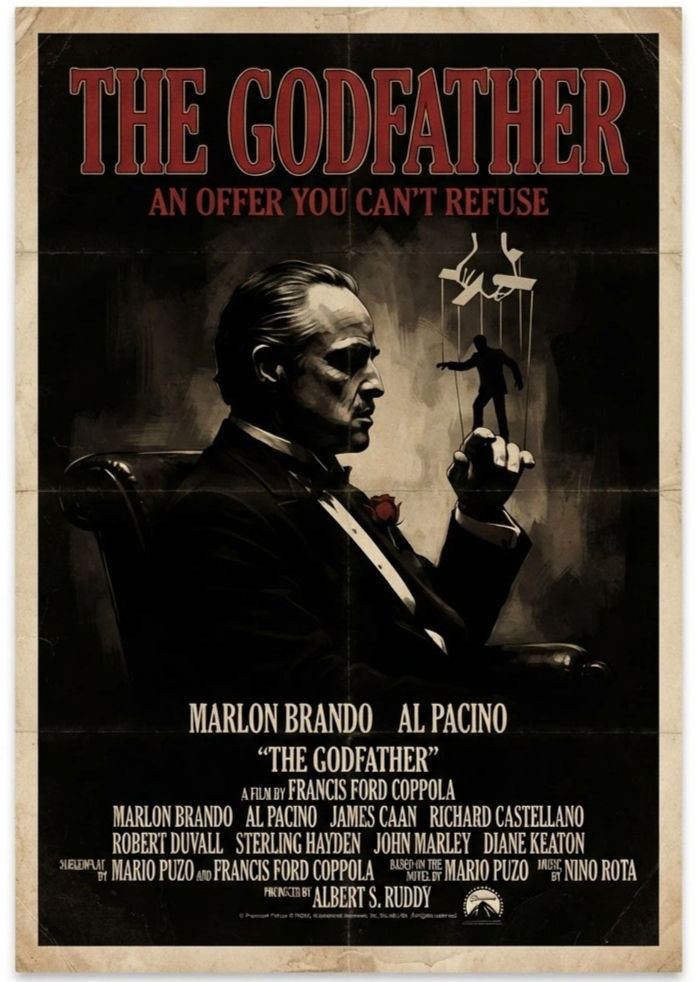
The Godfather (1972) — The Chiaroscuro World of Shadows and Sovereignty
To transition from the dust of the 1940s to the vintage New York of the early 1970s is to witness an entirely different style of cinematic translation. Francis Ford Coppola took Mario Puzo’s 1969 bestselling pulp crime novel and elevated it into an operatic, multigenerational tragedy.
The Visual Blueprint: Cinematographer Gordon Willis—affectionately dubbed "The Prince of Darkness"—painted the film in a rich palette of warm amber tones and impenetrable, deep black shadows. The film famously opens in a pitch-black office, contrasting the dark, insular underworld of the Corleone family with the bright, sun-drenched chaos of Connie’s outdoor wedding.
The Atmosphere of the Page: Coppola captures the dense, unhurried pacing of Puzo’s world by giving the characters room to breathe. Long, theatrical dialogues unfold across massive wooden desks, building intense psychological tension through posture, silence, and the clinking of heavy glassware.
The Cinematic Alchemy: Puzo’s novel leaned heavily on internal monologues about power and survival. Coppola translates this through absolute atmosphere—allowing the audience to feel the suffocating weight of Michael Corleone’s descent into corruption simply by watching the shadows slowly swallow him frame by frame.
The Lord of the Rings: The Fellowship of the Ring (2001) — Maximalist Practical Worldbuilding
At the turn of the century, director Peter Jackson took on the seemingly impossible task of adapting J.R.R. Tolkien’s 1954 high-fantasy masterpiece. It became a monumental turning point in cinema history, proving that immense, ancient literary mythology could be rendered with absolute cinematic prestige.
The Visual Blueprint: Jackson balanced the expansive, lush landscapes of New Zealand with a heavy reliance on practical filmmaking. The world feels tangible because it is tangible—achieved through painstakingly built sets, intricate armor, and massive forced-perspective miniatures ("big-atures") that seamlessly blend with early digital visual effects.
The Atmosphere of the Page: Tolkien’s prose is famously descriptive, deeply rooted in a love for folklore, nature, and language. Jackson honors this by balancing sweeping, cinematic action with quiet, domestic pauses. The comforting, green sanctuary of the Shire feels just as vibrant and important as the dark, cavernous depths of Moria.
The Cinematic Alchemy: The film successfully captures the vast, ancient weight of Middle-earth while anchoring the narrative in intimate human connection. Howard Shore’s brilliant, orchestral score serves as a secondary narrator, shifting from the light, whimsical whistles of the Hobbiton theme to the dark, booming brass of the ring's corrupting influence.

Harry Potter and the Sorcerer’s Stone (2001) —The Whimsical Gothic Warmth of Childhood Magic
Releasing in the exact same season as Fellowship, Chris Columbus’s adaptation of J.K. Rowling’s 1997 debut novel established the visual vocabulary for an entire generation of filmgoers. It treats magic not as a sleek superpower, but as a cozy, cluttered, and historically rich way of life.
The Visual Blueprint: The aesthetic leans heavily into a whimsical, gothic British warmth. Production designer Stuart Craig favored real, practical materials—heavy oak tables, massive stone fireplaces, dripping wax candles, and textured velvet school robes. The color palette is rich with deep crimsons, emerald greens, and the golden glow of thousands of floating candles.
The Atmosphere of the Page: The film carefully replicates the episodic, comforting rhythm of Rowling’s novel. It prioritizes the small, tactile wonders of discovering a magical world—visiting a dusty wand shop, the clatter of a sweets trolley on an old train, and the crisp crunch of autumn leaves turning to winter snow on the castle grounds.
The Cinematic Alchemy: John Williams’s iconic, melodic score provides the ultimate connective tissue. The delicate, sparkling notes of the celesta evoke an immediate sense of mystery and childhood wonder, instantly wrapping the viewer in a blanket of nostalgic comfort before a single spell is even cast.
Little Women (1994 & 2019) — The Ever-Shifting Mirror of the March Sisters
Louisa May Alcott’s 1868 domestic novel has been adapted to film multiple times, but comparing two specific modern versions reveals how directors can extract entirely different, beautiful layers from the exact same text.
       1994 Adaptation                     2019 Adaptation
┌───────────────────────────────┐   ┌───────────────────────────────┐
│ • Linear, chronological story │   │ • Non-linear, split timeline  │
│ • Cozy domestic sanctuary     │   │ • Artistic & financial focus  │
│ • Warm firelight & snowscapes │   │ • Golden youth vs. blue adult │
└───────────────────────────────┘   └───────────────────────────────┘
The Tactile Sanctuary: Little Women (1994)
Directed by Gillian Armstrong, this beloved version functions as the ultimate cinematic comfort. It is a linear, unhurried celebration of nineteenth-century domestic life. The atmosphere is built on the warm crackle of open hearths, the texture of hand-knit shawls, and snow-dusted orchard paths. It views the March home as a sacred, cozy refuge from the cold world outside, focusing deeply on sisterly love and community kindness.
The Fragmented Mirror: Little Women (2019)
Greta Gerwig takes Alcott’s text and brilliantly restructures it into a non-linear narrative, shuffling between the warm, golden-hued memories of childhood and the cool, blue-toned realities of adulthood. Pacing is quick, witty, and overlapping. Gerwig honors the book's progressive roots by placing a heavy focus on female artistic autonomy, the economic realities of marriage, and Alcott’s own relationship with her publishers.

V. The Living Architecture of the Screen
As the credits roll and the screen fades back into shadow, we are reminded that film adaptation is not a simple act of duplication, but a sacred conversation across time. It is a creative alchemy that bridges the solitary sanctuary of reading with the communal magic of the theater. From the stark dust of John Ford’s West to the fractured, modern light of Greta Gerwig’s New England, these filmmakers do not merely replicate our favorite characters—they build a home for them to live in.
The next time a autumn rain rattles your windowpanes, I invite you to slow down your evening ritual. Light a single amber candle, pour a fresh cup of tea, and look at your favorite films with a curator’s eye. Notice the way a shadow falls across a room, how a musical note hangs in the quiet air, or how a single, unhurried frame can capture pages of a character’s unspoken heart. For in the end, both the deckled page and the silver screen offer us the exact same gift: a beautiful, unhurried space to practice our curiosity, to stir our empathy, and to lose ourselves completely in the timeless art of the story.


Comments